Diamond Anniversary Celebration Kicks Off with Rolex 24 Win
By John Oreovicz
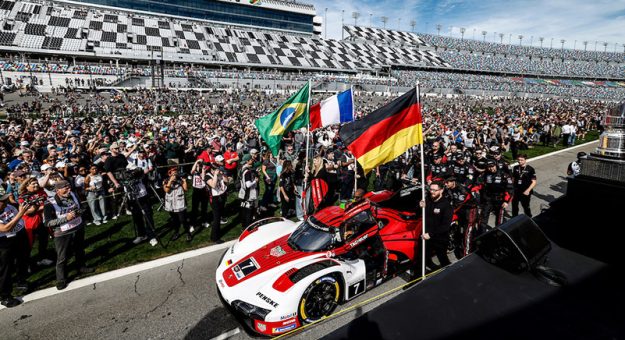
DAYTONA BEACH, Fla. – One of the most compelling storylines about Porsche Penske Motorsport’s third consecutive overall victory in the 2026 Rolex 24 At Daytona was that it created the perfect start for celebrating the 60th anniversary of the formation of Team Penske.
Somewhat lost in the excitement for Penske was the fact that 2026 is also the milestone 75th year of competition for Porsche Motorsport. The German marque’s illustrious racing history dates to 1951, when a 356 ‘Gmund’ coupe claimed the 1,100-cc class victory at the 24 Hours of Le Mans while finishing 20th overall. Porsche now owns more overall Le Mans wins than any other manufacturer (19, including seven consecutive between 1981-87) as well as a record 21 overall wins (and 25 powered by a Porsche engine) in the Rolex 24.
During this year’s Rolex 24, Porsche brought together a diverse panel to reflect on the manufacturer’s 75 years of sustained success on the racetrack.
The participants included IMSA Hall of Famer Hurley Haywood, who notched five overall wins at Daytona driving the 911 Carrera RSR, the 911-derived 935, and a 962 prototype. He also earned Le Mans triumphs in three iconic Porsche prototypes – 936, 956, and 962.
Haywood later shared a Porsche-powered Fabcar Daytona Prototype in the 2005 Rolex 24 with Timo Bernhard, then a Porsche Junior driver who would soon be tabbed to join a collaboration between Porsche Motorsport and Team Penske.
A Team Penske Porsche RS Spyder produced three consecutive LMP2 class championships in the American Le Mans Series between 2006-08. Bernhard and Romain Dumas clinched the LMP2 title in 2007 and ’08, and in the latter year, they also guided the Le Mans Prototype 2 (LMP2) Spyder to overall victory at the Mobil 1 Twelve Hours of Sebring.
The RS Spyder toppled the theoretically faster and more powerful LMP1 class entries for overall race wins 11 times between 2006-08, with Bernhard and Dumas earning nine of those trophies.
Jonathan Diuguid joined Team Penske straight out of college in 2005 and was immediately assigned to the nascent RS Spyder project, where he designed parts and served as a ‘DAG’ (Data Acquisition Geek) and assistant race engineer. From 2010-17, Diuguid worked with Penske’s IndyCar program before returning to sports cars in the IMSA WeatherTech SportsCar Championship when Penske joined forced with Acura to field prototypes in IMSA’s top class. With Diuguid leading the engineering effort, the Penske Acura ARX-05s claimed the Daytona Prototype international (DPi) class title in 2019 and ’20.
When Penske announced a collaboration with Porsche for IMSA’s new Grand Touring Prototype class starting in 2023, Diuguid was named the program’s Managing Director. Porsche Penske Motorsport has locked up the last two GTP class championships with the Porsche 963, and they started the 2026 season with Felipe Nasr, Julien Andlauer, and Laurin Heinrich taking the overall laurels at the Rolex 24.
First Impressions
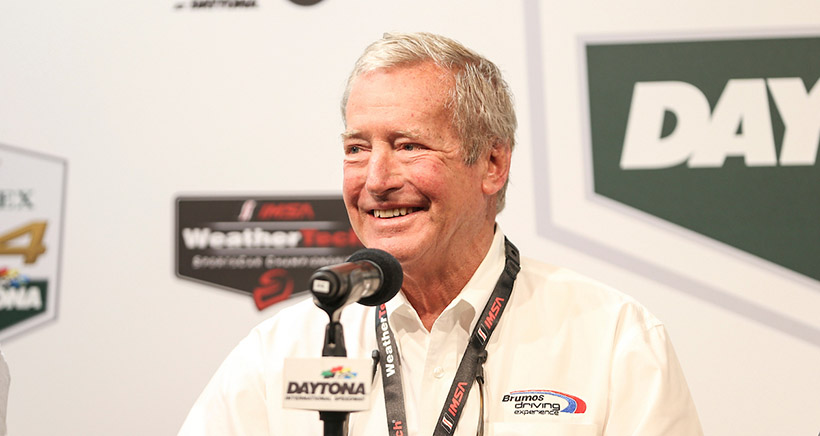 Haywood’s first experience with a Porsche prototype came in 1973, driving the legendary 917-10 in the SCCA Can-Am championship.
“With 1,200 horsepower and a lot of aerodynamics, it was quite tricky and quite a handful to drive,” Haywood recalled. “That was a tremendous jump forward from a 300-horsepower 911, but Mark Donohue gave me some good advice and said, ‘You’ve got to be really careful with this car. Take small steps, and then eventually, you’ll catch up.’ That’s exactly what I did, and I was third in the championship behind Donohue and George Follmer.
“I think when Porsche looked at that, they thought, ‘If he can handle that car with really no experience in a prototype, maybe we should look at him to come on for Le Mans (in 1977),’” Haywood continued. “The first year I was paired with Jurgen Barth, then Jacky Ickx had some problems with his car, so they moved Jacky over to our car. Jacky was brilliant at night in the rain – which I’ll tell you is pretty daunting at Le Mans – and we won the race. That sort of opened the door for Porsche and me.”
Bernhard had a solid record racing GT-class Porsche 911s, including multiple victories at the Nurburgring 24 Hours and the ALMS GT class championship, when he got the nod from Porsche to make his first prototype start in the 2005 Rolex 24.
“We had five drivers on that car!” he laughed. “I was with Hurley, JC France, Romain Dumas, and Mike Rockenfeller. The car didn’t handle that well and we didn’t finish the race. Then I remember I got a call from Roland Kussmaul in August 2005 who said, ‘We’ve got a beautiful RS Spyder at Weissach (the Porsche Motorsport headquarters and test track outside Stuttgart), and we need a driver for some gearbox testing. How fast can you be there?’ I said, ‘Two hours, but if the car is waiting, I can make it in 90 minutes!’
“I went hammering down to Weissach, and I got my first experience in the RS Spyder. I fell in love with this nimble little LMP2 car with lots of downforce. That’s when the RS Spyder program kicked off, and that’s when Penske Racing came into my life. Later that year, I met Roger Penske for the first time in person, along with Tim Cindric, and Jonathan, who was an engineer on this program. We won three straight LMP2 championships and we won the 12 Hours of Sebring overall. That’s really where my Porsche career kicked off.”
Diuguid, then in his early 20s, has fond memories of the RS Spyder program and the start of his successful association with Team Penske.
“My first experience with a Porsche prototype was the first track test run outside of Weissach,” he said. “It was at Jerez, and it was very hot. We were very successful with the RS Spyder, and that has transitioned into the Porsche 963. It’s come full circle, really, in 20 years. It’s exciting to develop and work with a manufacturer like Porsche; racing is in their culture and their DNA and their blood, and it’s amazing to be successful with them over almost two decades.”
Greatest Hits
With a racing career that spanned more than 40 years, Haywood got to experience many of the most revered Porsche racing cars.
“The 936 was a wonderful car; I loved that car,” he reminisced. “The last version of that car in 1981 had the intended Porsche Indy engine, and that was a real sweetheart. Then we evolved into the 956 and the 962, and from a racer’s standpoint, those cars had so much grip it was like a dream come true. It was like a railroad track going around a corner. They were all great cars, and we had great success with them. But even the 962 was very fragile and you knew that as a driver, if you made a mistake and hit somebody, you were going to need some major bodywork done. Now the cars are so strong and so reliable that everybody is driving like it’s a sprint race. That was unheard of in my day. We had to be careful with the cars, and we had to be careful with the transmission. It was a completely different platform.
“The pressure placed on the modern drivers is enormous, in my opinion,” Haywood added. “Not only do they have to drive quickly, avoiding accidents while going as fast as they can go, but at the same time, the engineers are talking to them constantly about handling improvements. The only time my crew would call me is if I was on fire. It’s a whole different way of doing it and I’ve really got to give a hand to the current drivers that they can handle all those different components.”
People Power
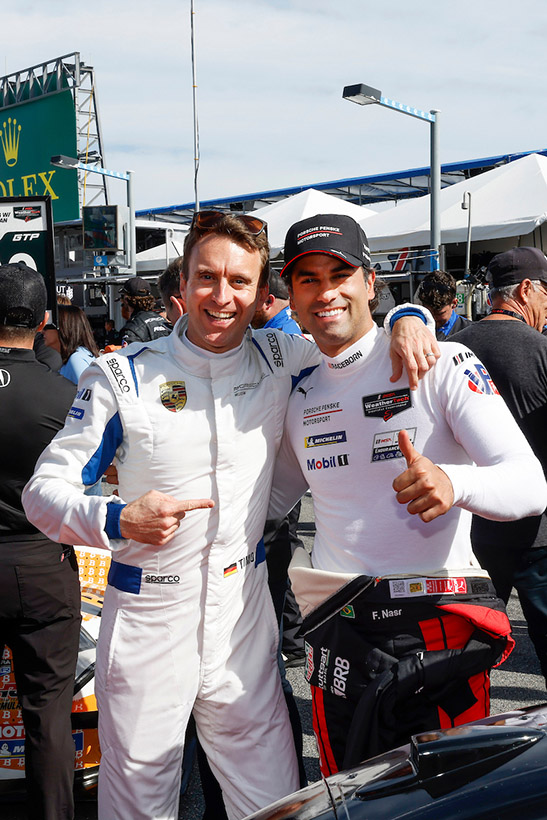 Bernhard gave credit for his success with Porsche to the litany of legendary figures who have contributed to the Motorsport program over the decades, from Peter Falk, Norbert Singer, Hans Mezger, and Roland Kussmaul to the current director of the program, Thomas Laudenbach.
“The nice thing about my 20 years with Porsche is it was not going from one era to another,” Bernhard reflected. “Thomas Laudenbach was the head of drivetrain on the RS Spyder, so I’ve known him for 20 years. Same with Jonathan, who was an engineer on the RS Spyder program. All these people have been very loyal. You get to know them.
“My big influence at Porsche at the very beginning was Roland Kussmaul – a great engineer and a very good driver, with a lot of influence on the Le Mans and Dakar Rally programs. He was an essential part of my development and one of the heroes I got to know when I was young. Another true legend is Norbert Singer. I never really worked with him because he was far before my era, but he was someone I really looked up to and rate very highly.”
Haywood also benefitted from Porsche’s engineering expertise and team-oriented philosophy.
“One of the wonderful things about Porsche is they are able to put people together that are proven people,” he noted. “They’re not out there to prove that they’re better than somebody else; they work as a team. All the co-drivers and the crews had that same mentality. You’re not out there to try to be the best or the fastest. You’re out there for one purpose, and that is to win the race.”
Back to the Future
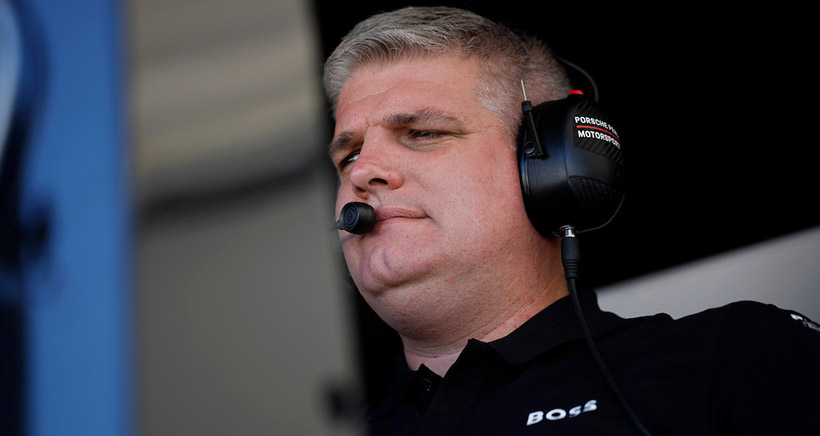
Years from now, when the Porsche 963 program reaches its conclusion, Diuguid will be included as one of those Porsche legends, as well as a key cog in the Penske organization. In mid-2025, Diuguid was promoted to the position of President of Team Penske, assuming responsibility for Penske’s IndyCar team while maintaining his role running the Porsche 963 effort in IMSA.
“The attitude within the group is that nothing is impossible,” Diuguid remarked. “Anybody can ask any question, and it will be looked at to see if it can bring performance. That’s the thing that continues to allow the Porsche-Penske relationship to be competitive. We’re never satisfied with the results we’ve had previously, don’t rest on our laurels, and are constantly trying to improve.
“It’s a process going from the bad days to the good days, and standing on top is probably as difficult as getting there,” he added. “That’s probably the biggest thing in the relationship that everybody focuses on. It’s a non-compromising attitude, which can be a difficult environment to operate in. But as long as everybody has the same goal and the same drive, the groups can achieve great things together. We’re still trying to build the history.”