Key New Partnerships Announced Reveal Collaboration and Advancement
By John Oreovicz
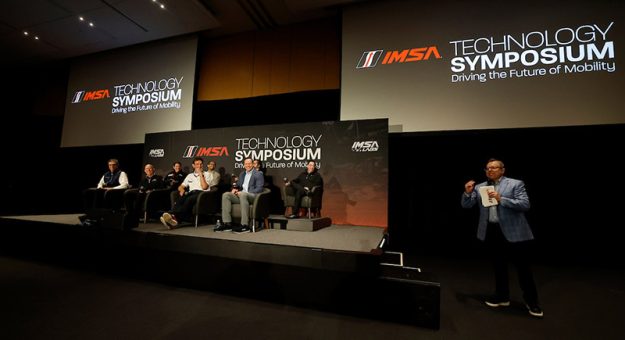
DAYTONA BEACH, Fla. – Friday morning of Rolex 24 At Daytona race week brought with it the third annual IMSA Technology Symposium on the campus of Embry-Riddle Aeronautical University, located adjacent to Daytona International Speedway.
The forum, again led by NBC Sports personality Leigh Diffey, featured a diverse panel of executives representing car manufacturers, component suppliers, tech giants including Amazon/AWS, Microsoft and NASA, for a discussion on the theme “Driving the Future of Mobility.”
“Motorsports and, in our case, aviation and aerospace, have a lot in common,” said Embry-Riddle President Dr. Barry Butler in his welcome remarks. “We’re driven a lot by competition, and in terms of the technology, advancing things along the way.”
IMSA used the occasion to announce several new technology-related initiatives, including:
- A multi-year Space Act Partnership with NASA (National Aeronautics and Space Administration) to collaborate on cutting-edge research and technology exchange that will feature two Technical Interchange Meetings every year.
- The launch of IMSA Labs, a formalized platform for collaboration between IMSA and its automotive and technology partners. Global advisory and professional services agency BDO USA has been designated the Official Digital Transformation Partner of IMSA Labs.
- Sentronics Limited, which has provided IMSA with fuel flow measurement equipment since 2018, has become a Proud Technology Supplier.
This is the second of this two-part series (part one here) highlighting the IMSA Technology Symposium, with focus on the new tech developed in sports car racing and more on the NASA partnership with IMSA.
Case Study: New Tech
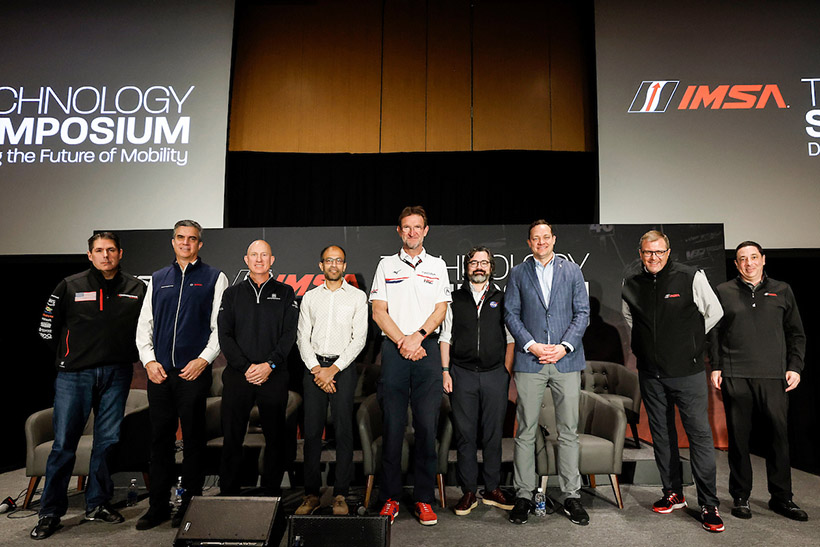 CJ Moses (furthest left) occasionally drives a GT2-specification Audi R8 in sports car racing events. His day job involved working for the FBI until 2007 when he joined Amazon Web Services (AWS), where he now serves as chief information security officer and vice president of security engineering. AWS is a key technology partner for IMSA, supplying equipment and computer and cloud services vital for capturing telemetry data in real time.
“When you get up every morning, you probably don’t think, ‘Oh, data! I want to see more data!’” Moses joked. “Let’s just say that data itself is not very interesting. But the reality is that IMSA makes data exciting because it’s around race cars, and the amount of data that comes off a GTP (Grand Touring Prototype) car allows us the opportunity to showcase the abilities that we have with that data using generative AI and all the new technology terms. We can show the benefit of actually diving into that data and making things better, not only for faster race cars, but better spectator engagement, to be able to use that data in a meaningful way.
“Innovation for innovation isn’t really worth anything,” Moses continued. “Innovation for the sake of a purpose – and in this case, to be able to actually bring better racing for all the spectators as well as for all of us that race and want to go faster, is really meaningful. IMSA Labs will be able to actually get that real innovation turned into results. And delivering results is really what matters.”
As Principal Research Manager for Microsoft Research, Siddhartha Sen (fourth from left, in-between GM’s Eric Warren and HRC’s David Salters) often deals in hypotheticals. He can barely hide his excitement about the usable data that IMSA sports car racing creates.
“I think what’s fascinated me about motorsports items in general has been the quality of the data and the diversity of the amount of human data that’s out there,” he said. “Just by training imitation learning techniques on the human data that’s generated we can, with just a few hundred laps, drive our cars at the top 1 percent of human performance. To me that speaks volumes about the quality of the data.
“The sim-to-real gap for racing has really kind of blown me away,” Sen continued. “The only other domain I’ve seen that kind of low gap maybe is with flight simulators. It’s just uncanny how people who, in online racing sims, perform. And that can kind of translate to what they see on the actual track. And I think that kind of low gap is a reason why we’re able to train and create models that can actually be useful in real life. And this is why I’m very excited about the IMSA platform in general. I love the theme I’ve heard across the panel today about how much you stress things on race day. It really makes me appreciate what we’re doing, even beyond races like Formula 1, because the kind of stress that you’re putting the cars through and the kind of data you’re collecting during the next 24 hours, I don’t think you can simulate that in a lab. It’s kind of like gold being able to get access to it.”
Case Study: NASA
As Embry-Riddle President Dr. Barry Butler observed in his opening comments, the automobile (especially racing) and aviation industries share many commonalities.
“Roughly 99 years ago, a guy named Charles Lindbergh left Long Island and found his way to Paris,” Butler said. “That was driven by the Orteig Prize. And if you go from that point forward, a lot of the technological advances in our industry – whether it’s in space, aviation, mobility, autonomous vehicles, drones – are driven by people getting together and sharing technology, but also competing. And that’s what ultimately drives people to get better and better and safer as they move it along.”
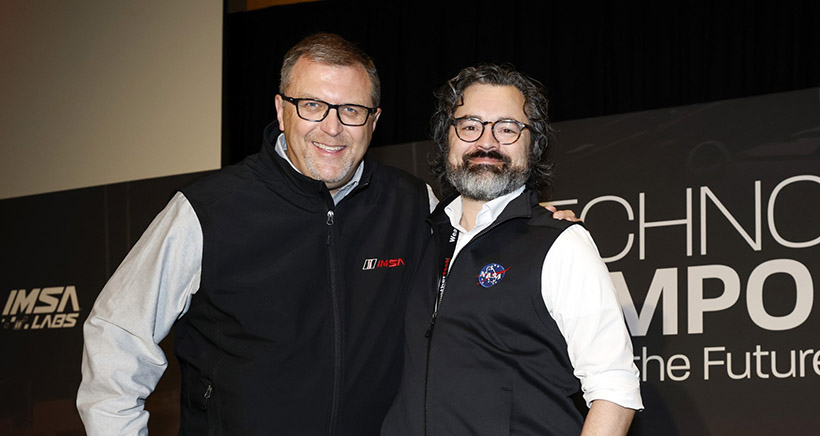 Ian Maddox, chief engineer for NASA, was a participant in the IMSA Technology Symposium in 2025, and the experience whetted his appetite for greater collaboration with IMSA to the point where IMSA and NASA have entered into a Space Act Partnership.
“Y’all (IMSA) are honestly kind of on fire,” Maddox exclaimed. “You guys are doing cool stuff all the time, every day, right? And you’re that closed loop. The speed with which you guys can cycle back through the design process and iterate on the things that you’ve learned is really kind of awesome, from NASA’s perspective.
“We try to do really hard things, right? We’ve got SpaceX Crew 11, Crew 12, Harvest 2,” Maddox continued. “But our ‘race days’ only come up like once every four years. And so, the opportunity to participate in something like IMSA Labs, moving at a cycle speed that’s so much faster, gives us really an unprecedented opportunity to start moving at the same speed that you guys have already found yourselves. We’re really excited about IMSA Labs because it gives us a way to start collecting those lessons learned and then bring that back, not just to the Group Mars work, which is kind of my home. Honestly, the rest of the agency is really starting to see where this can take us.”