
Tech On-Track and Tech Worlds Collide at Third Annual Event
By John Oreovicz
DAYTONA BEACH, Fla. – IMSA is known for featuring the most technologically advanced racing cars competing in America. The tech world is now taking notice.
At the third annual IMSA Technology Symposium, held at Embry-Riddle Aeronautical University adjacent to Daytona International Speedway, a diverse panel of executives representing car manufacturers, component suppliers, tech giants and even NASA – yes, that one – graced the stage to discuss the theme, “Driving the Future of Mobility.”
This two-part series highlighting the IMSA Technology Symposium will cover different topics from the symposium. First up is a look at the intertwined aspects of IMSA Labs launching in tandem with why OEMs race in IMSA. There are 18 OEMs committed in 2026, including 12 that participated in the IMSA WeatherTech SportsCar Championship’s 64th Rolex 24 At Daytona.
IMSA Labs is a formalized platform for collaboration between IMSA and its automotive and technology partners. Global advisory and professional services agency BDO USA has been designated the Official Digital Transformation Partner of IMSA Labs.
“Bill France Sr.’s vision for Daytona International Speedway was a place where the automotive industry, technology companies, and tire companies could prove their product, test their product, perform, and showcase what their brands stand for,” commented IMSA President John Doonan. “And I thought about Bill looking down and how proud he would be of what we are doing. The manufacturers are here and Michelin is here to perform on the racetrack – to perform with technology but also use it as a massive marketing platform.
“Today, the announcement of IMSA Labs takes it to the next level,” Doonan continued. “I think the fact that Daytona International Speedway and Embry-Riddle Aeronautical University are sharing fence lines, if you will, is a real statement about what we’re trying to do. Why now? It’s time. We want to look forward. We want to learn from the past, but we want to be innovators on the IMSA side and formalizing it is absolutely the right thing to do. In the end, we are here to go racing, but we are also here to prove technologies, entertain our fans while doing it, and share the fact that for 55 years, IMSA has always been a laboratory.”
As OEMs and suppliers relate, the lab work done in IMSA isn’t theoretical. It’s practical, real-time data transfer with problem-solving.
Case Study: OEMs
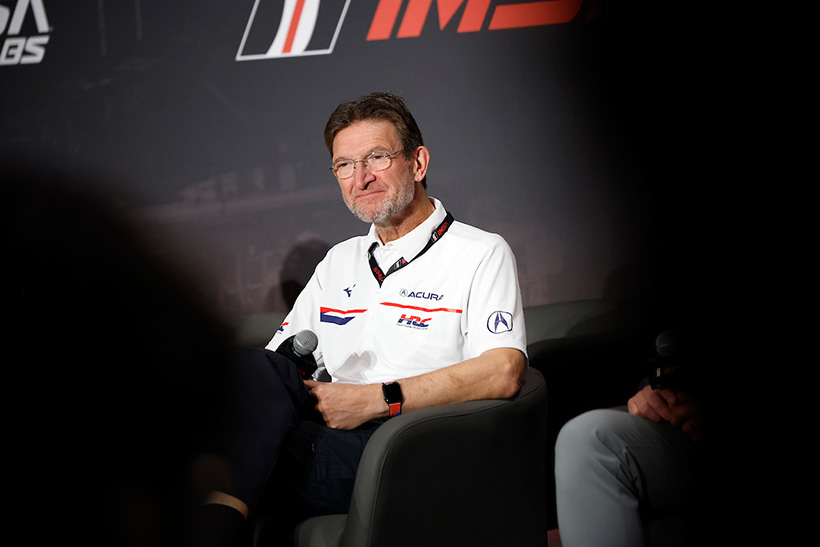 Car manufacturers have raced their products since the very dawn of the industry. IMSA’s status as the technological leader in American motorsport is what motivated Honda Racing Corporation (HRC) USA to design and build the Acura ARX-06 that competes in the WeatherTech Championship’s premier Grand Touring Prototype (GTP) class.
HRC USA President Dr. David Salters revealed that the level of technology in a GTP car is very similar to Formula 1 – in some cases, actually more advanced.
“What’s underneath these cars – the level of software and vehicle dynamics – is very similar,” Salters remarked. “The lovely thing about GTP, it is open software architecture. If we can think it, we can write it and do it. In some ways, software-wise, we have more freedom. And we literally develop stuff in days and hours. In the first practice of the Roar (Before the Rolex 24 test session), we had a small problem, and we quickly rewrote some code, sent it back to the factory, and an hour later it was sorted. That is the ultimate software-defined vehicle.
“The challenge is the same,” he continued. “What is interesting, and also which differentiates it compared to F1, is we’re about to do 24 hours – that’s 12 races of F1 in succession. We have to go and do half a season, perfectly, in one go. That’s a very different challenge to Formula 1, very masochistic, to do half a season, right, the first time, without a single error. And these days, the level of competition, it’s just a sprint. You cannot slip up.”
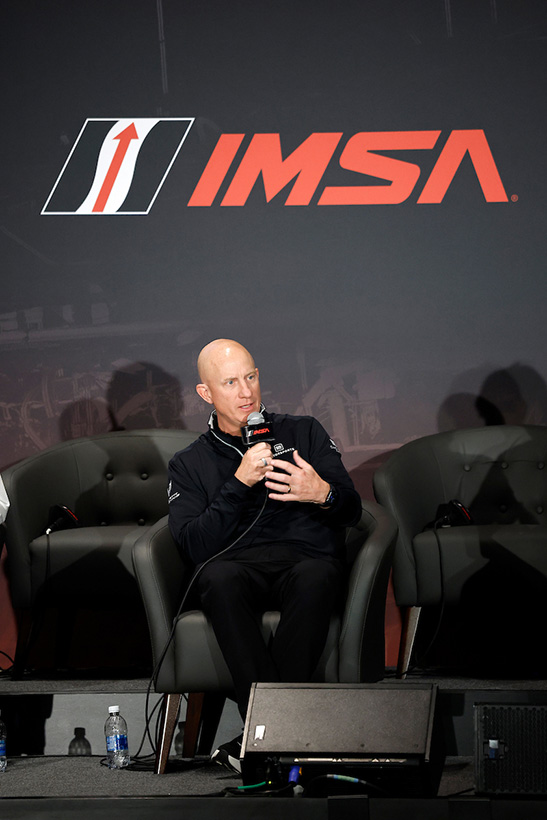 Like Honda, General Motors uses racing as a tool to develop people and technology. GM’s presence in the WeatherTech Championship includes three Cadillac V-Series.R GTP prototypes, and multiple teams fielding the Chevrolet Corvette Z06 GT3.R in the Grand Touring Daytona (GTD) and GTD PRO classes.
“They say the race starts with or without you, right?” noted Dr. Eric Warren, Vice President, Global Motorsports Competition, General Motors. “It really teaches engineers to advance quickly, to be able to analyze data, adapt, discard things, and inside of General Motors, we really connect engineering and motorsports directly. Motorsports really resides in the engineering group. As we develop new simulation methods and things, it directly connects with the groups that are designing our cars. And so not only do we get to compete brand against brand, but it also helps us train engineers relating to those technologies and drive that technology that ends up on the road.”
“That’s why we race in different categories,” he added. “IMSA as a whole, gives you different conditions and conditions that change that require you to learn and develop technologies that are directly applicable to cars.”
Case Study: Suppliers
That real-world laboratory or proving ground aspect is also what attracts companies like Michelin and Bosch to IMSA. Michelin recently extended its contract as exclusive tire supplier for the WeatherTech Championship for 10 years, and this year has introduced a new tire for the GTP class that warms up faster, lasts longer, and incorporates 50 percent sustainable materials.
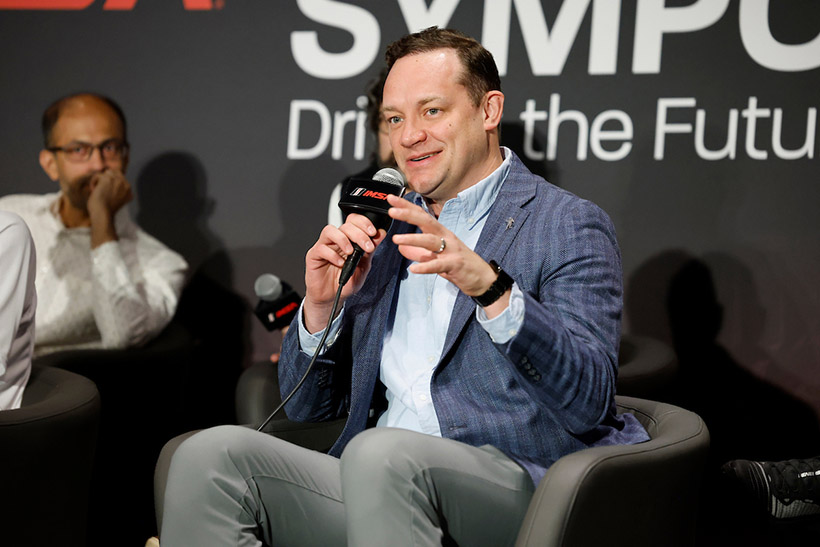 “We’ve been at this for our whole history – 135 years,” observed Matthew Cabe, President and CEO of Michelin North America. “We started in bike racing and Michelin has always been pushing hard. And the best place to learn from our technology is here on the track. For us, what’s special about endurance racing is over a very short amount of time, we’re able to really see what our product is able to do and learn from that. When you look in the paddock and see Michelin folks running around everywhere, many of these people are designing products during the regular week. They’re designing tires.
“So literally, what we do is we learn here on the weekend and then Monday morning, back in the office, we’re designing, based on what we learned over the weekend, into the products that we can drive ourselves through the rest of the week,” Cabe continued. “For us, it’s really an opportunity to push the edge of what’s possible, and we keep doing that like in the recyclable materials we’re putting in the product. It gives us the opportunity to really test and learn out here, and we really take that back and apply it to the products we put on the street.”
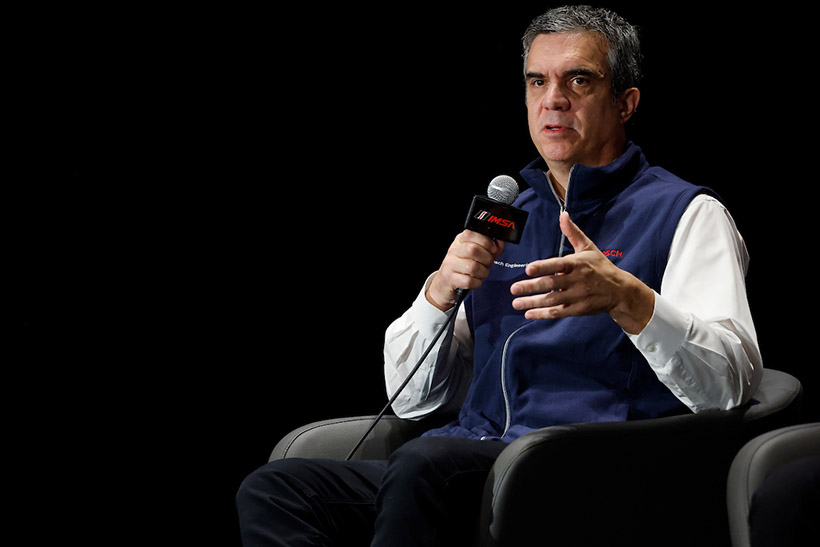 The same logic applies for Bosch, which supplies many of the components in the common hybrid system used in GTP cars. Bosch also equips IMSA with the myriad of sensors mounted to cars in every WeatherTech Championship class that permits the sanctioning body to collect and analyze data and ensure a level playing field for all competitors.
“I see the relationship between IMSA and Bosch as really a win-win situation,” declared Joe Capuano, Regional President, Bosch Engineering. “We’re able to bring our technology and components that we use in our everyday vehicle engineering and automotive business in different ways for the racetrack, where obviously the requirements are different, and it’s really a loop of learnings.
“The pace of what’s required at the racetrack, with respect to being able to make software updates and being able to process data, that is something that we really want to bring to our automotive business,” he noted. “And honestly, customers are requiring it now. The days of 3-, 4-, and 5-year development cycles, those are in the past. The pace, the expectation, the people aspect – bringing these types of competencies and skill sets from racing into automotive business – is really something I’m excited about.”