DNA Link Between Track and Street Evident for This Porsche Model
By John Oreovicz
DAYTONA BEACH, Fla. – There are many appealing things about the cars that race in the Grand Touring Prototype (GTP) class of the IMSA WeatherTech SportsCar Championship. One of the most exciting is the simplest:
The startup.
From sitting silently at stop, an electric motor provides the initial propulsion to push the car off the line before the internal combustion engine kicks in with a jolt of noise and forward thrust. To many, that sound is the most captivating part of the process.
Strangely enough, you experience many of the same sensations when driving a Porsche 911 – in this case, a 2025 911 Carrera 4 GTS Cabriolet. Sitting at a traffic light, the engine is silent thanks to the fuel-saving stop-start function. The instant you start to move your right foot from the brake pedal to the accelerator, an electric motor (as opposed to a traditional solenoid starter) sparks the 3.6-liter flat-six engine into a fast idle with that unmistakable raspy 911 sound.
In a flash, the Porsche Doppelkupplungsgetriebe (PDK, or dual-clutch transmission) is taking you through the eight gears pretty much as fast as you want to go. If you’re on a closed course and you’ve selected the Launch Control function that is part of Porsche’s Sport Chrono package, you’ll reach 60 miles per hour in 3 seconds flat, pass through the quarter mile in 11.2 seconds, and carry on to a top speed of 194 mph.
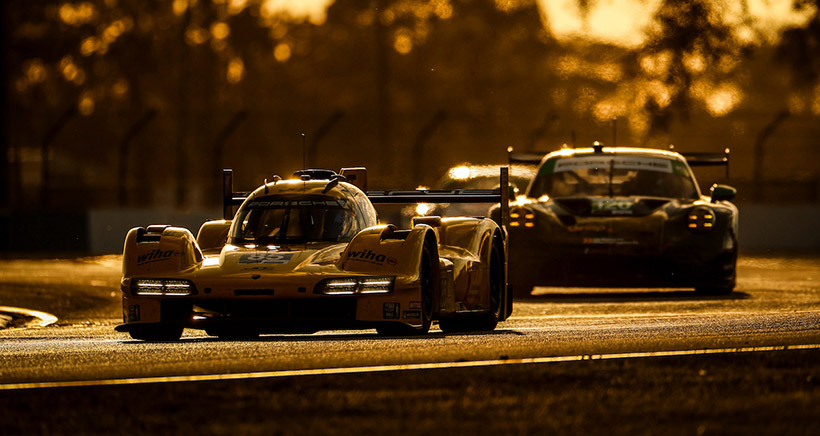 Convertible top aside, the resemblance between the Carrera 4 GTS Cabrio and the Porsche 911 GT3 R (992) that competes in IMSA’s Grand Touring Daytona (GTD) and GTD PRO classes is obvious. But it’s the two-time IMSA GTP championship-winning 963 Hybrid prototype with which the 911 Carrera GTS in any form (Coupe, Cabriolet, or Targa, 2-wheel drive or 4) shares its philosophy – if not the same hybrid technology.
The 992-generation Carrera GTS models feature Porsche’s newly developed T-Hybrid system, which mates a redesigned 3.6-liter flat six producing 478 horsepower and 420 lb.-ft. of torque with an electric motor that adds another 53 hp and 110 lb.-ft. for a total of 533 hp and 450 lb.-ft. An additional electric motor works in conjunction with the ICE powerplant’s single turbocharger.
In the GTP class, all competing manufacturers integrate standardized hybrid components with the combustion engine of their choice – for the Porsche 963, it’s a twin-turbocharged 4.6-liter V-8 derived from the 918 RS Spyder.
Porsche used lessons learned from three seasons campaigning the 963 in the WeatherTech Championship and the FIA World Endurance Championship in creating the T-Hybrid suite of components for the roadgoing 911 GTS – in particular, the function of the electric turbocharger and regeneration of energy under braking.
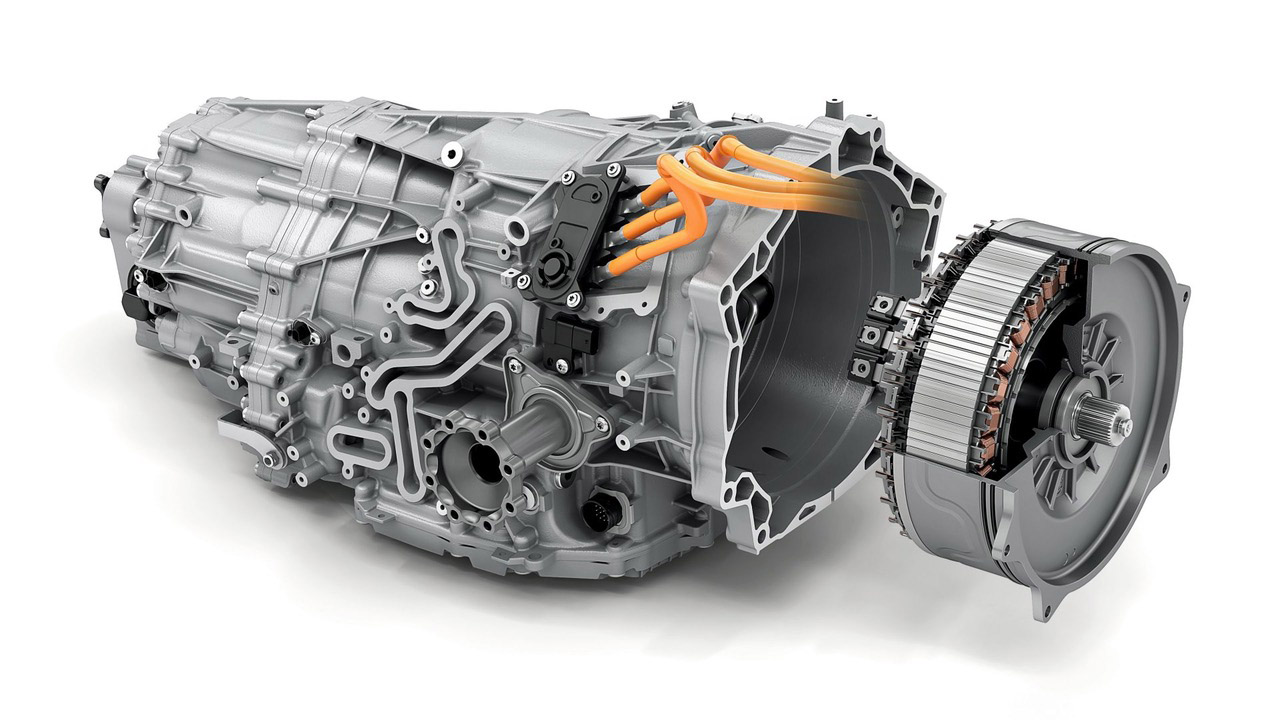 Like the 963, the 911 GTS incorporates its main electric motor between the engine and the transmission. That electric motor (left, courtesy of Porsche) eliminates the need for a standard starter, which is what makes the start-up process between the two cars sound so similar. Unlike the racing car, the T-Hybrid offers no full electric mode.
Thanks to the elimination of all belt drives and other technological innovations, the new 3.6-liter ICE is 4.3 inches lower than the outgoing GTS model’s 3.0-liter flat six, allowing the additional hybrid components to be packaged within the same space. The T-Hybrid system, including its small 1.9 kWh lithium-ion battery, adds just 110 pounds to the car.
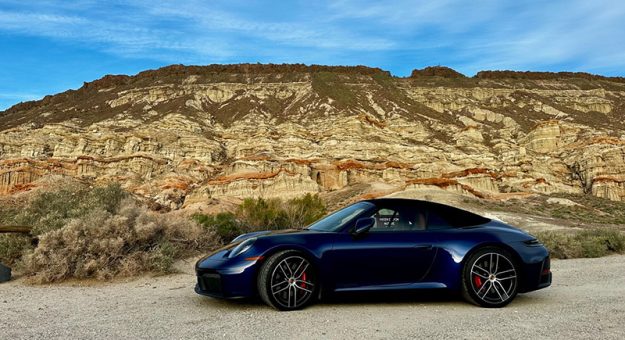
Porsche was kind enough to provide a Gentian Blue Metallic 911 Carrera 4 GTS Cabriolet for evaluation recently when I was in Southern California. Arriving at 8 p.m., I was immediately reminded that one of the most remarkable aspects of any 911 is how comparatively easy it is to drive in city traffic. The PDK transmission eliminates the need for a clutch and shifting gears, though a manual mode with paddle shifters is right there waiting. Forward visibility is outstanding, rear-view mirrors are large and effective, and – width of the fenders shrouding those massive 315/30 R21 rear tires aside – guiding a 911 across greater Los Angeles can be as simple as driving a VW Golf.
 But that’s not really what a Porsche is built for, so once my work commitments were done the next day, I pointed the Carrera 4 GTS northbound in search of what Road & Track magazine used to call “Sports Car Country.” Traffic on California 14 thins out nicely once past Palmdale and Lancaster as I aimed toward Willow Springs International Raceway, billed as America’s oldest permanent road course. Recently upgraded and under new ownership, Willow Springs is a popular venue for new car launches, road tests, race car testing, and film shoots, and it looks like it would be a ton of fun to drive in any car.
That wasn’t possible on this day, so I had to be content with the satisfaction of a spirited run up Tehachapi-Willow Springs Road before continuing northwest toward Bakersfield on California 58. Here on open, empty roads, the Porsche really comes into its own and you can go some way toward enjoying its amazing acceleration, braking, and cornering.
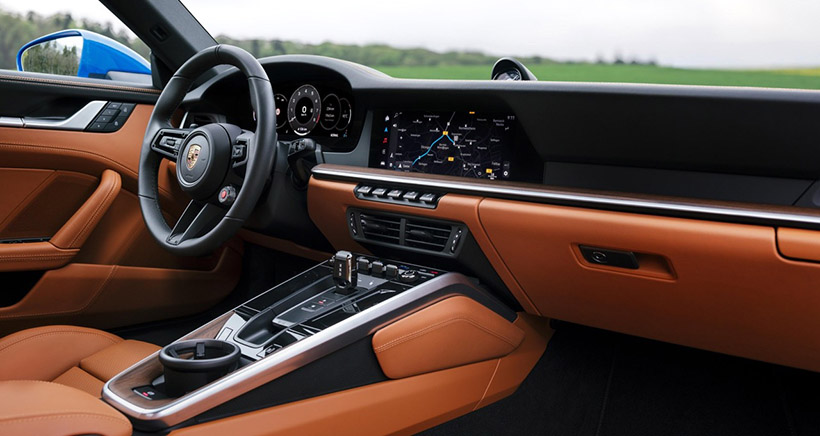 The most impressive aspect of Porsche’s T-Hybrid system is how seamless and unobtrusively it operates, boosting acceleration while also contributing to fuel economy. I averaged nearly 27 miles per gallon over a 250-mile mix of highways, back roads, and urban crawling (driver seat photo courtesy of Porsche).
“With the T-Hybrid system, we are taking the next logical step in the continuous, innovation-driven development of our core models,” said Frank Moser, Porsche’s Vice President for the 718 and 911 models. “It significantly increases efficiency and future-proofs the 911 philosophy with even better performance.”
Of course, none of this technology comes cheap. T-Hybrid equipped 911s start at $175,900 for the 911 Carrera GTS, and the Carrera GTS 4 Cabriolet I sampled carried a sticker price of $216,085. That sounds exorbitant until you realize that well-equipped pickup trucks often approach $100k these days.
In Los Angeles and Atlanta (and other locations around the world), Porsche offers an easy opportunity to sample a range of its products. Convenient to LAX and ATL airports, the Porsche Experience Center puts you behind the wheel for a 90-minute road course session with a professional coach for as little as $500 in a 718 Cayman. If you’re more serious about getting to grips with a Porsche in a racetrack setting, Porsche Track Experiences ranging from one-half to three days are available at Barber Motorsports Park and WeatherTech Raceway Laguna Seca.
Today’s liquid-cooled, turbocharged, hybrid-assisted Porsche 911 with active aerodynamics is a quantum leap from the comparatively humble original that debuted back in 1965. Only a handful of modern sports cars have that kind of history, but none can match the 911’s combination of character, charisma and everyday practicality.
Photos by John Oreovicz (Porsche exterior), Porsche (technical and driver seat shots) and IMSA (No. 85 JDC-Miller MotorSports Porsche 963, No. 120 Wright Motorsports Porsche 911 GT3 R 992)