
Distinguishing What Lights Serve Which Purpose on a Sports Car can be Illuminating
By Tony DiZinno
DAYTONA BEACH, Fla. – IMSA WeatherTech SportsCar Championship night races bring out all of the lights. Distinguishing what lights serve which purpose can be illuminating.
Headlights and Leader Lights are fairly well-known. Headlights vary in color by class, while Leader Lights clearly indicate the position each car runs in class via LED panels.
Running Lights, or Identification Lights, require a little deeper dive into their usage.
Running Lights serve a few different purposes:
- To help spotters (and fans) better identify the cars in darkness
- To aid crews and drivers in making pit stops and driver changes during night stints
- To provide Race Control and course workers additional visibility to cars on course, running or stopped
The role these lights play for everyone around the course is key, since the car number panels – which are black, blue, orange, red and green, respectively, for Grand Touring Prototype (GTP), Le Mans Prototype 2 (LMP2), Le Mans Prototype 3 (LMP3), GT Daytona Pro (GTD PRO) and GT Daytona (GTD) – aren’t as visible in night conditions.
“The lights are designed to help the spotter identify the car,” explains Sean Creech, team principal of Sean Creech Motorsport, whose team seeks to defend its Mobil 1 Twelve Hours of Sebring LMP3 class win later this month.
“From up on top of the tower where spotters are, you can see the car through the tri-oval (at Daytona). But once it goes through Turn 1, it’s harder to pick out car colors. The spotter needs the light on the car to see it.”
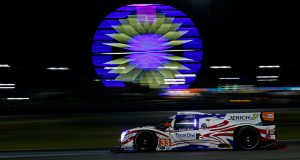
That’s where the location of the Running Lights comes into play, which is slightly different from 2022 to 2023.
Running Lights are subject to IMSA approval. Red or green identification lights are prohibited, as are external installations or lights forward of the A-pillars in the cockpit area. Modifications of homologated components are prohibited.
Regulatory changes have shifted these Running Lights largely to around the cockpit area, and not on the roof.
Additionally, the new GTP class cars are fitted with three pairs of red/green HV condition lights. These lights determine whether these hybrid cars are safe or unsafe to touch.
Teams can affix the Running Lights to best suit the preference of their drivers and crews, while also aiding the spotters.
“In the past, we had a red/white/blue light that was just behind the windshield,” Creech said. “This year, the spotters had to find one vertical light on the window.”
Teams have taken different approaches toward putting on these Running Lights in 2023.
The aforementioned No. 33 Creech Ligier JS P320 and No. 13 AWA Duqueine D08 LMP3 cars use lights in the door panel.
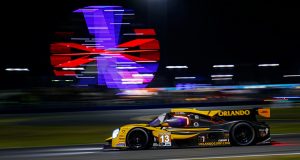
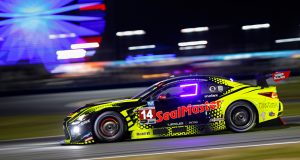
Shifting to GTD PRO, the Vasser Sullivan Lexus team runs a purple three-line set of lights inside the doors.
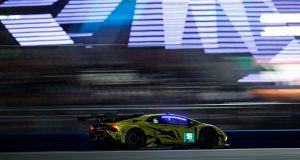
The No. 19 Iron Lynx Lamborghini Huracán GT3 Evo2 opts for a single strip just below the driver name panel, away from the Leader Light panel displayed behind the B-pillar on the back window.
And the new No. 80 AO Racing Porsche 911 GT3 R (992) incorporates three strips around its Leader Light panel, behind the B-pillar.
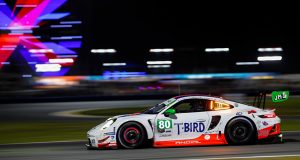
It’s one of the more underrated but important aspects of the IMSA Michelin Endurance Cup, where three of four races have a nighttime component. Keep an eye out for these examples and more of Running Lights as day turns into night on March 18 in the Mobil 1 Twelve Hours of Sebring.