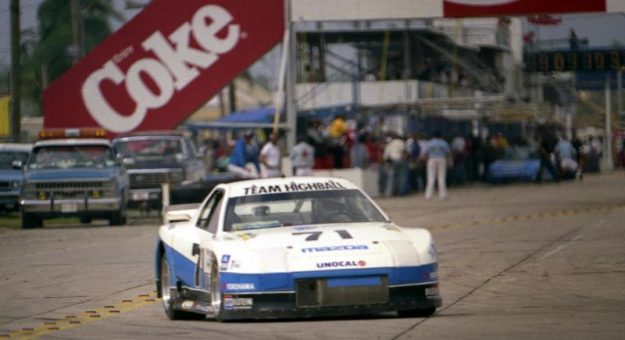
It wasn’t planned, but it was a happy coincidence. This weekend, the two Soul Red Mazda RT24-Ps that compete in the IMSA WeatherTech SportsCar Championship are sharing the track with the Mazda RX-7 that took the IMSA GTU victory at the 12 Hours of Sebring 30 years ago.
While the Mazda RT24-Ps are aiming for victory in the Prototype class at this weekend’s Mobil 1 Twelve Hours of Sebring Presented by Advance Auto Parts, the No. 71 Team Highball Mazda RX-7 is taking part in the HSR vintage races. At Sebring in 1988, Dennis Shaw and Amos Johnson drove Johnson’s Team Highball Mazda RX-7 to the victory in GTU with a two-lap margin over another RX-7 driven by Bart Kendall and Tom Frank. Locking out the GTU podium was another RX-7, driven by Dick Greer, Matt Mnich, John Dinger and Mike Mees.
The Sebring result highlighted a period when Mazda RX-7s were dominant in IMSA’s GTU class, as Shaw and Johnson’s victory was the eighth-straight in the class for the Mazda RX-7. It was also their second victory of the year, as they had won the 24 Hours of Daytona in GTU just a few weeks earlier in the same car – which won Daytona four years in a row.
Johnson’s conservative approach to the endurance races, combined with the reliability of his Mazda, helped to make him a force in endurance racing at the time.
“Any time we ran the endurance races, like Sebring, the drivers would try to set a pace,” said Johnson. “We would calculate a pace that would win the race if the car didn’t have any issues, but also allowed us to run competitive times and keep the car healthy. By the end of the race, we were out there by ourselves. So, we would usually run the early part of the race kind of staying in touch with our competitors and then at some point someone would start pushing it – our idea was to make our car last, and make the other guy break down.
“That was the plan, but there were some other tricks too. We would not draft, we would stay well behind and run our own race because at Sebring there was a danger that the car in front would kick up a chunk of concrete and then you are stuck in the pits changing a windshield.”
The rotary-engined Mazda RX-7s were mainstays for years in IMSA GTU competition. Johnson’s Team Highball example is arguably the most successful of the period as it eventually accumulated five victories at Daytona as well as well as its victory at Sebring. Constructed initially in 1985 by Johnson after an IMSA rule change allowed tube-framed cars, it was constructed in one month in Team Highball’s North Carolina shop.
“It was quite an effort, but we built the car in one month’s time,” said Johnson. “I built the engine in that car too, with help from Roger Mandeville. I studied engineering at Duke University, and I had tinkered with a few other cars, but when I was ready to do this I designed the whole car.
“Even now, if you study the car you’ll see there are things on there that my crew and I came up with that were pretty radical. There are some things that we were able to do because of the rotary engine – it’s lighter weight, so we don’t have as much front weight on the car. It was very reliable, very fast, and easy to drive.”
Thirty years on, the Mazda RT24Ps run by Mazda Team Joest will aim to bring another Mazda to victory lane at the end of the Mobil 1 Twelve Hours of Sebring.